 00:0300:0313:34
 11:0312:39
A trucking business here means running a Class 8 semi (a sleeper or day cab tractor) as an owner-operator: hauling freight for brokers and shippers under your own USDOT and MC authority, or leased on to a bigger carrier. Owner operator trucking needs a CDL, a used truck, expensive first-year insurance and cash to survive 30 days before brokers pay. This guide covers how to become an owner operator and run a trucking business with one truck, using real numbers from 10 operators and insiders.
No money needed. If you don't have a CDL yet, price local CDL schools first.  07:3107:4608:51
 07:30
Each clip opens at the exact moment on YouTube.
11:01 03:24
 01:0406:5012:39
 04:41
You get a CDL, buy or finance a used semi (often a $30,000–80,000 sleeper or day cab), and either lease on to a carrier that supplies freight and paperwork for a cut, or file for your own USDOT and MC authority and book loads yourself from load boards and brokers. The biggest early costs are the truck and first-year trucking insurance. Brokers usually pay in 30–60 days, so you either keep a month or two of cash in reserve or use freight factoring for 2–5%. Profit depends on your cost per mile, not the gross on a load: fuel, insurance, payments, maintenance and empty miles all come out first. Operators say the first one to two years on a new authority are the hardest. 01:4302:1905:0303:14 07:20
Four quick questions about the day-to-day work the creators describe.
Real US Google searches, and an example of local competition. Data from DataForSEO, 2026-11-24.
00:3708:4222:4804:3303:3011:01Trucks resell, but usually for less: one owner sold a Peterbilt he'd bought for $70,000 (plus a new transmission) for $54,000, and another lost $30,000 on a truck bought at the market peak. On finance, your loan stays if the business doesn't work. 11:3011:3302:00
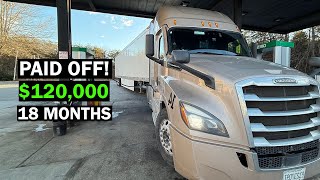
Our estimate A $13,476 own-authority start ÷ about $7,500 a month (what one operator put toward his loans) ≈ 2 months to win back your cash. Clearing his whole $115,000 truck and trailer loans took about 18 months, and he says living rent-free with his parents made that possible. 11:0112:3911:0310:01
The order the operators and compliance consultants describe, from licence to first load. Tick steps as you go; progress saves on this device.
One young founder's plan was a single printed page: where the money comes from, how you get the first revenue, and how you keep it going. Here's one filled in with this guide's figures. Swap in your own numbers. 27:2827:39
| Operation | One used sleeper or day cab; dry van, reefer or power only; own authority or leased on 02:58 02:4600:37 |
|---|---|
| Startup budget | ~$13,500 financed, or ~$45,000 buying a day cab cash; keep $5–10K extra 11:0106:3612:35 |
| Insurance | $18,000–25,000 in year one for a new carrier; one operator's renewal fell to about $10,000 by year three 05:1003:2015:32 |
| Weekly running costs | One day cab: ~$1,200 diesel, ~$500 insurance, ~$100 subscriptions, $300 maintenance reserve 02:5403:0103:2204:08 |
| Revenue goal | $8–10K gross per truck per week, about three regional loads 17:57 |
| Cash flow | Brokers pay in 30–60 days: keep a month's revenue in reserve or factor for 2–5% 05:0312:0502:19 |
| Maintenance fund | Set aside 20% of gross, or about 25 cents a mile 03:5005:32 |
| Break-even | About 2 months to win back a $13,500 cash start at $7,500 a month (our estimate) |
Trucking is regulated federally and by each state. This is only what the sources described for a semi truck and trailer; rules, fees and minimums change, so check FMCSA and your state's rules (and your insurance agent) before you file or haul anything. It is not legal advice. 00:1905:20
| Requirement | What the sources said | Sources |
|---|---|---|
| USDOT and MC number | Interstate carriers apply to FMCSA for both, $300 non-refundable; no CDL or truck VIN needed to apply. Intrastate: a DOT number, free | 03:2407:2805:55 |
| Activating the authority | The MC authority goes active once insurance and a BOC-3 (process agent, ~$100–150) are on file; register with UCR (~$50) | 04:2508:0808:10 |
| Trucking insurance | Federal minimum liability of $750,000 cited; hazmat needs $5 million. New carriers paid $18,000–25,000 for year one, with a down payment from about $2,000 to $6–10K | 06:2406:5505:1006:1706:01 |
| What moves the insurance price | Operating radius, how long you've had your CDL and DOT number, what you haul, and the driver's age and record | 04:4521:2005:17 |
| Plates and fuel tax | IRP apportioned plates ($1,800–2,500 when first set up), IFTA decals and quarterly reports, 2290 heavy vehicle use tax over 55,000 lb | 06:4905:5408:1906:45 |
| State permits | New York, New Mexico, Kentucky and Oregon need their own permits (Oregon asked for a $2,000 bond); some states add numbers of their own | 07:2312:5205:20 |
| Drivers and safety | Driver file even if you're the only driver, drug and alcohol consortium, Clearinghouse check, medical card, ELD, annual DOT inspection, DOT folder for roadside checks | 13:5414:0714:2214:5114:4315:07 |
| New entrant audit | New interstate carriers register for, and must pass, a safety audit | 05:3806:19 |
| CDL age | 18 to drive within your state, 21 to cross state lines | 07:03 |
Leased on, you run your truck under a carrier's authority and they keep a share of each load. With your own authority you keep the whole rate but carry the insurance, paperwork and finding freight yourself. 01:0407:09
| Leased on to a carrier | Own authority | |
|---|---|---|
| What it costs you | A headline 35% split was really ~15–17% for one driver once trailer, liability insurance and factoring were counted | 01:0403:30 |
| Insurance | Liability usually in the carrier's cut (on 90/10 deals you probably pay it) | 01:50 |
| Freight | The carrier's direct customers, some paying up to $7 a mile | 04:18 |
| Own authority: freedom | Haul for anyone, take time off when you want, add direct customers later | 22:03 |
| Own authority: the catch | $18–25K insurance, negotiating every load, chasing payments; the first 6–12 months are the hardest | 05:2022:4800:37 |
Where most new carriers start; learn which lanes and markets pay
15:1403:1111:06Posted rates are lowball: brokers often add $200–600, and one posted at $1,700 settled at $2,050
22:5403:36You haul their freight, including direct customers paying up to $7 a mile, for a cut
04:18These are the load rates and fees operators gave. Rates swing with the market, so compare every offer with your own cost per mile.
| Job | Price | Sources |
|---|---|---|
| Dry van, Chicago to Charlotte | $3,200 |  12:24 |
| Dry van back to Chicago, New Year's | $1,850 | 10:33 |
| ~600 miles, posted $1,700, negotiated | $2,050 | 03:36 |
| ~700 miles home in Christmas week | $1,600 to high $2,000s | 00:25 |
| Power only, California (day cab) | $4–5+ a mile | 02:49 |
| Sacramento to Phoenix · LA to Bakersfield | $3,000 · ~$1,200 | 04:5705:06 |
| Spot load from a load board | Over $3 a mile | 23:26 |
| Freight factoring or broker quick pay | 2–5% of the invoice | 02:19 |
| Dispatch service | 3–6.5% of revenue | 02:39 |
| Maintenance reserve (example) | ~25 cents a mile | 05:32 |
07:3107:4609:4513:1213:3703:0822:4805:1703:0806:4207:4035:2305:4910:4916:2823:3502:1506:5012:3506:4303:5012:0515:2103:2021:2005:2001:3507:3603:0822:4811:06The mistakes the creators say they made, ranked by how many of them mention it.
03:1402:1511:4713:3711:5211:3915:2107:5205:52Figures here are owner operators' own numbers for one truck. Fleet results and napkin maths are listed separately below.
12:3904:23* “Profit” is before income tax. The day cab was bought cash, so it carries no truck payment. The $7,500 a month is what one operator put toward his loans while living rent-free with his parents, which he says is hard to replicate. Weekly figures × 4–4.33 for months. One trainer puts typical trucking company margins at just 2.5–8%.
06:0407:1022:2116:4701:0422:0311:0106:4808:3108:31Real operators from the source videos. Results are as they told them.
00:0300:0313:3411:0312:3900:12 Facebook Marketplace for $32,000. His first insurance quote was $57,000 a year; shopping around got it to $38,000.Five trucks in a year; $75–120K a month in revenue00:1221:2021:4216:3700:0900:0902:4904:2300:0000:0007:2211:3013:4814:3711:5205:0304:4108:4200:3706:0712:2414:1718:1100:33
Labels show whether each speaker runs the business and whether they sell something. Dates are approximate, from YouTube's “x years ago”.